


Financial Fair Play - the future of football

Purpose

This site explores the issues of Financial Fair Play (FFP) in football. Note: This site is not affiliated to UEFA.

Understanding FFP

Click on the 'Financial Fair Play Explained' tab for diagrams, videos and explanations of the UEFA rules.  


News, articles and information

If you want to get in touch about FFP, please contact the site.

Contact www.financialfairplay.co.uk

Financial Fair Play News (click on the article headline to post comments)

Financial Fair Play Survey

Will Platini follow through with FFP? Will Chelsea be banned? Does it matter? Please complete the short survey to give your views on FFP.


 Will Manchester City pass the FFP test? 17 May 2012

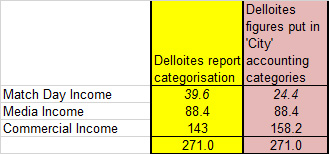
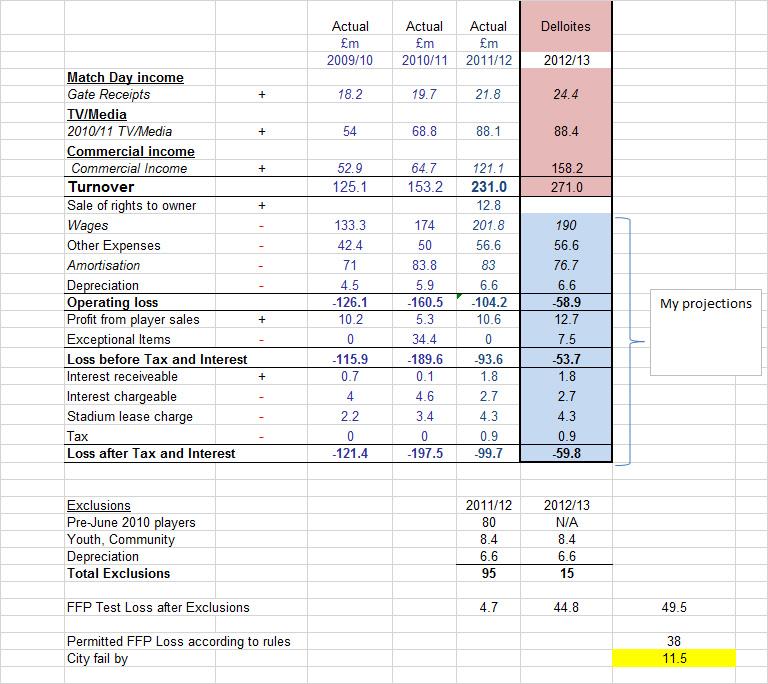
Following the dramatic events at the Etihad, I have received lots of interest from people asking the same question: “Will City pass the Financial Fair Play test?”  To answer this question you need to make a large number of assumptions about the club’s footballing and financial performance.  The assumptions that I have used are outlined in the Notes section but in summary they include the following main assumptions:

  • City continue their success and win the Premier League, FA Cup and reach the Champions League final next year

  • City continue their extraordinary 25% year-on-year growth in Commercial income (topping £100m in 2012/13)

  • City make no major sales or purchases next season (this prediction is probably unlikely but it provides a base to work from).

As with all projections, there are huge number of variables and each one is open to challenge.  However the club accountants will also be wresting with many of the same predictions regarding, League position, Champions League performance, and even the Euro exchange rate.

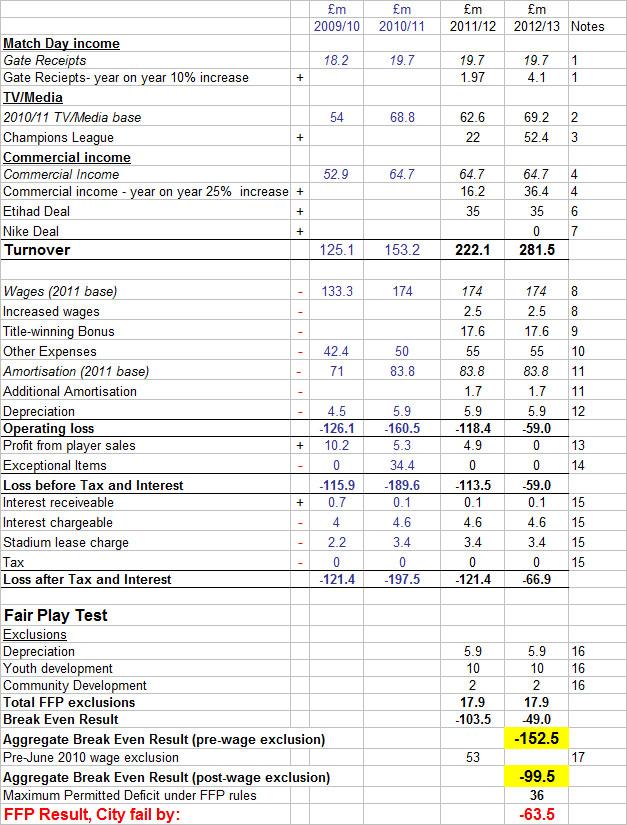
Projection (£m):

 My projection has City failing the FFP test for the first Monitoring Period by £63.5m. See also the technical note below under heading Annex X1 regarding this figure.

I have used a mixture of known information and 'best case' assumptions for the projection.  If I had assumed a less successful season where City only reached the last 16 of the Champions League, did not win the FA Cup, City would be £32m worse off and would fail the FFP test by  £95.5m.

This article continues in two parts - part one  part two

Readers can post comments at the end of the pages - please post comments at the end of part one.


UEFA Financial Fair Play rules explained in 6 minutes

I have uploaded a new video that explains the UEFA FFP rules in just 6 minutes. 

Football Financing in the Premier League 11 May 

Now that all clubs have finally published their accounts for last season (Liverpool being the laggards), UK newspapers are starting to produce their analysis of the finances of the Premier League clubs. 

Matt Scott in the Telegraph produced an in-depth analysis of club accounts, including net transfer spending (something that isn't easily identifiable).  It is highly recommended.

James Lawton in the Independent wrote a very interesting article about the lack of governance in the Premier League and also published a table of club debt, which I have re-ordered and shown below.

Premier League debt
Chelsea £734m
Manchester United £439m
Fulham £190m
Newcastle United £150m
Liverpool £123m
Aston Villa £110m
Arsenal £97.8m
Bolton Wanderers £93m
Tottenham £78.6m
Wigan Athletic £73m
Sunderland £66m
QPR £56.1m
Everton £45m
Manchester City £41m
Blackburn Rovers £21m
Norwich £16.8m
Stoke City £8m
West Bromwich £2m
Swansea £0m
Wolves £0m

There are a few interesting things to notice. For all the jibes directed towards Man City, it is important to recognise that the owner doesn't load debt onto the club (the £41m shown above  appears at the end of the accounting period and the owner will pay-off any underlying debt by buying equity in the club).  Wealthy benefactors such as Abramovic, Ashley (Newcastle) and Al-Fayed (Fulham) have still not yet converted the club debt to equity (a pattern generally repeated at other benefactor clubs).

Falling Euro makes it harder for English clubs to pass FFP test 7 May 2012

UEFA's Financial Fair Play rules spell out how much a club is a able to lose and still comply with the FFP financial requirements.   The figures are all documented in Euros.  Clubs struggling to comply with the rules will have noticed that the falling Euro is making the task much more difficult.

 The chart above shows how much the Euro has fallen since its July 2011 peak. The first and second Monitoring Period limits have fallen by almost £4.5m..

It remains to be seen whether UEFA will be lenient with English clubs who miss the targets because of exchange rate fluctuations.  Premier League clubs could argue that the goalposts have moved since they signed up to the rules.

UEFA might point out that any Premier League clubs buying players from the Eurozone will benefit from lower transfer fees as a result of the Euro's exchange rate slide. There could however be a considerable benefit for any club that has agreed a number of player contracts that are denominated in Euros.

The Bundesliga - a vision of the Premier League future? 2 May 2012

Although this site takes a generally positive view towards UEFA's Financial Fair Play rules, it is important to appreciate that the changes carry some risks for the Premier League.


Many journalists, fans and people working in football are concerned that UEFA's Financial Fair Play rules will reduce the excitement of the Premier League and that the larger clubs will dominate the domestic competitions. Martin Samuel from The Mail is one of the more outspoken critics of the rules, but he is certainly not alone in his concern about the effects of FFP.   In future, wealthy owner will not be allowed to spend their own money in the pursuit of success - even if an owner is prepared to put funds into the club via equity (as Sheikh Mansour does at City), they will simply not be allowed spend to achieve their ambitions for the club.   Many would agree that City and Chelsea have added welcome excitement and variety to the Premier League - both clubs are funded by wealthy owners.  And it is not just the uber-wealthy clubs that will be impacted by the rules - in future clubs will not be able to 'speculate to accumulate' and won't be able to spend much more than they receive to 'chase the dream'. Swansea and Norwich have both made fairly big financial losses in recent years - other clubs will not be able to follow the same approach.  The main worry is probably that the rich clubs will get richer and that the smaller clubs will not be able to break into the top tier - they will lose their top players to the bigger clubs and consequently the Premier League will become stupefying dull, consistently dominated by a small number of very wealthy clubs that continue to vacuum up the commercial benefits of their success.

This view of the football is certainly both powerful and worrying.  However it could be argued that the post-FFP world is already with is - we can see how FFP will affect the Premier League simply by looking at the Bundesliga.

The Bundesliga already operates in a  Financial Fair Play environment. The majority of German clubs break-even and there is political pressure used by the Bundesliga to discourage overspending. Other than Wolfsburg and Levekeusen the clubs operate on a model whereby the fans own 51% of each Bundeliga club.  Consequently, there is no scope for wealthy owners to inject huge funds into buy success - the wealthy benefactor model doesn't operate in Germany.   The Bundesliga is dominated by Bayern Munich, who occupy a similar historic position as Manchester United. As in the Premier League, the large clubs usually take part in the Champions League most seasons and enjoy the benefits of the Champions League money.   So, if the nightmare scenario of the post FFP future is correct, we would expect the Bundesliga to be significantly more dull and predictable compared to the Premier League. However, the German reality is actually somewhat different.

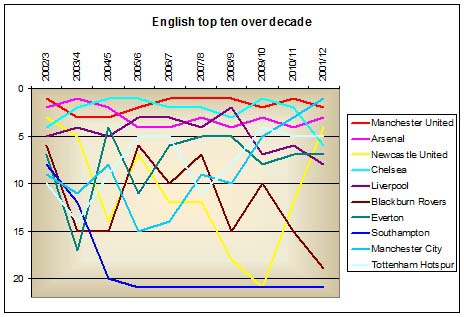
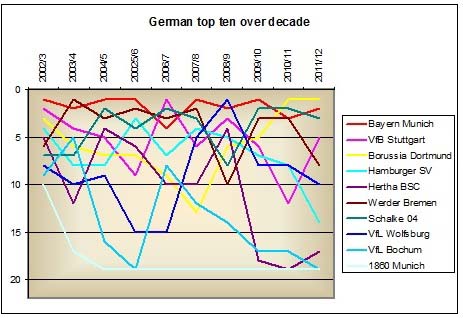
The attached graphs show how the top 10 clubs in 2002 have fared in the succeeding years 10 years. 

 Note: the 2011/12 positions are as at today's date and could well change a little by the end of the season. To keep the scale comparable, relegated clubs are shown bumping along the bottom of the graph, rather than in their actual league position.


The more 'chaos' and 'noise' in the graphs, the more variety in League position. There is clearly greater variety in clubs' league position in Germany. The position at the top of the chart is also noticeably more unsettled in Germany. Obviously Bayern dominate the Bundesliga, but, to a somewhat lesser extent than Manchester United. There also hasn't been the same dominance of 4 or 5 big clubs in Germany as there have been in Premier League. In terms of variety, the Premier League is actually rather dull by comparison (even allowing for the performances of Newcastle (£140m in debt to Mike Ashley) and Manchester City.

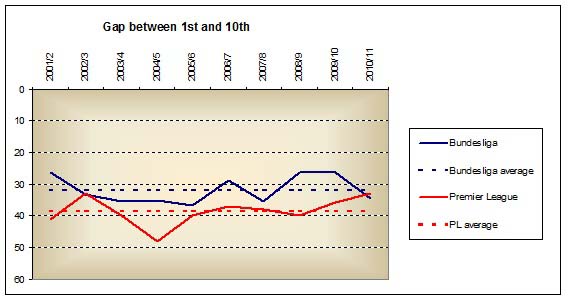
If we look at the gap between the Champions and the club in 10th place we see that the Bundesliga is usually a tighter contest than the Premier League - the club finishing 10th finishes consistently closer to the winners in Germany:

Note, German points are adjusted for the 4 fewer games in the Bundesliga.

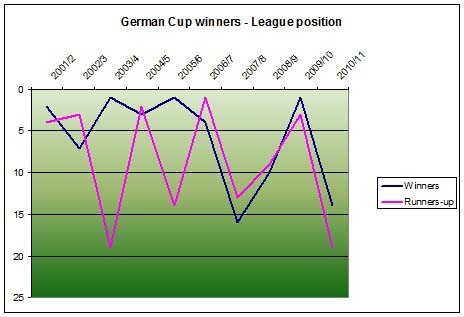
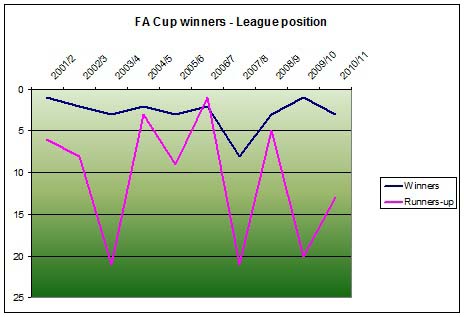
Looking at the League positions of the FA Cup winners and the German cup (the DFB-Pokal), we see that the German cup again provides more variety than in England (especially amongst the winners).  Whereas only one club outside the top 4 has won the FA Cup in England (debt-fuelled Pompey), 3 clubs have achieved this result in Germany.  The runners-up have achieved broadly similar league positions in both Leagues.

 Although this presents a more comforting view of the future, there is one notable differences between the two national leagues; debt. When FFP is fully up and running in the Premier League, a large number of teams will have significant historic debt issues to contend with - this simply  isn't the case in Germany.  There is a risk that the cost of servicing debt may restrict clubs ability to compete  and generate even less variety of league position we currently have in the Premier League.


The Bundesliga publishes an excellent English language annual review on the financial position and it makes interesting reading.  Unfortunately, the Premier League does not produce a comparable report.  Glenn Moore also  recently wrote an interesting piece on German football.

Fans may be kept in the dark over Football League FFP transfer embargoes 1 May 2012

The newly announced Championship and League 1 & 2 Financial Fair Play rules rely on the use of a 'transfer embargo' as the main sanction for overspending clubs in the Football League.  The first transfer bans for League 1 and 2 clubs under the new rules will commence from the start of next season (2012/13).  However the Football League have confirmed that fans may be kept in the dark about any transfer ban imposed on their team.


When contacted, the Football League explained that they have a 'longstanding policy not to comment publicly about the imposition of
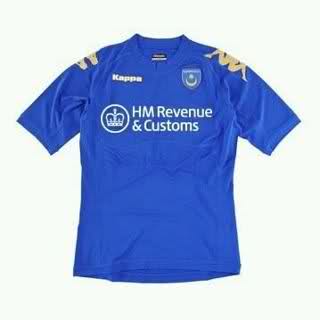
embargoes and that it would be up to the club's discretion whether they wish to make an embargo public'.   Unfortunately, League clubs have not always been good at informing their supporters - Portsmouth fans found out about their January transfer embargo through informal channels, some time after the ban was imposed.  There is a real risk that fans may be left in the dark as clubs seek to hide an embarrassing ban from their supporters. By leavint it up to the discretion of the clubs, the League appear to have missed an opportunity to ensure greater transparency and communication with fans.

The requirement to restrict expenditure on wages to less than  65% of turnover will be particularly difficult for clubs recently relegated from the Championship.  As things stand, Coventry, Portsmouth and potentially Sheffield United may have to do some clever deals in the summer to avoid an embargo - managing the communication process with their supporter may present an additional challenge.

Financial Fair Play rules introduced into the Championship 29 April 2012

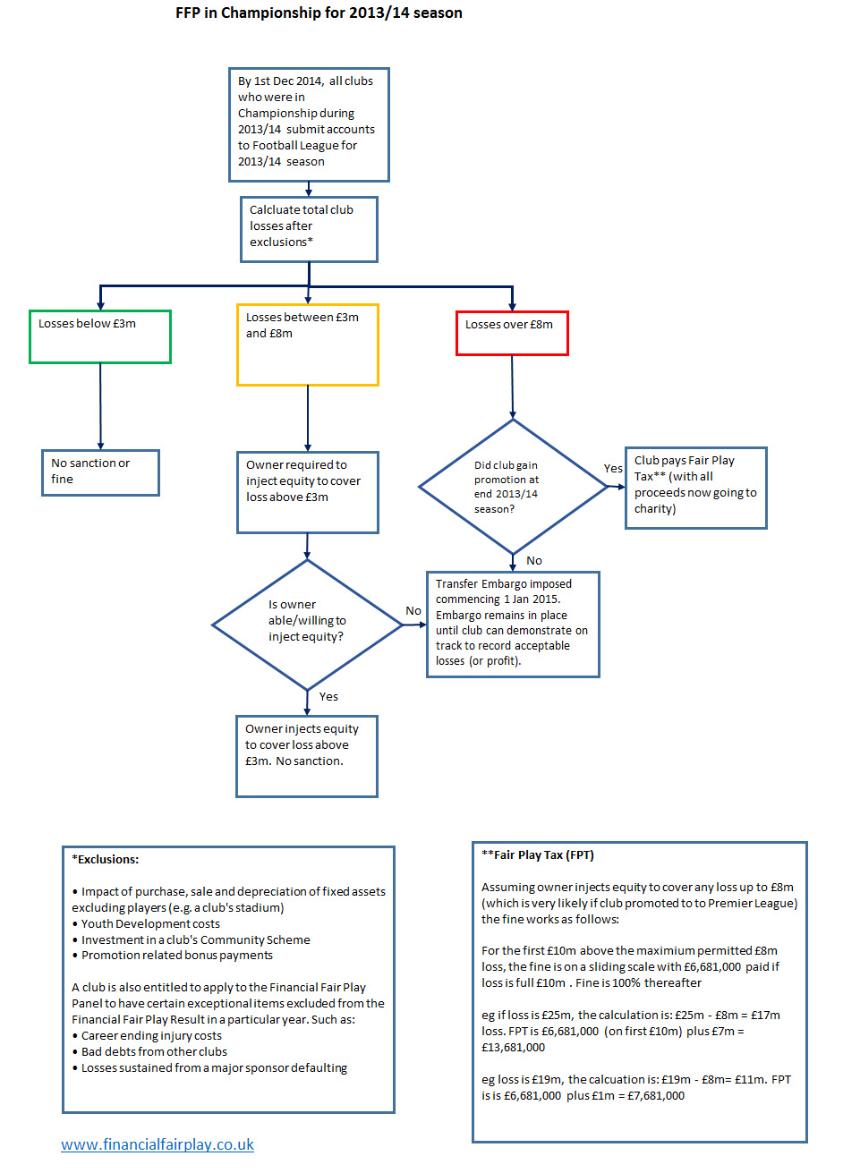
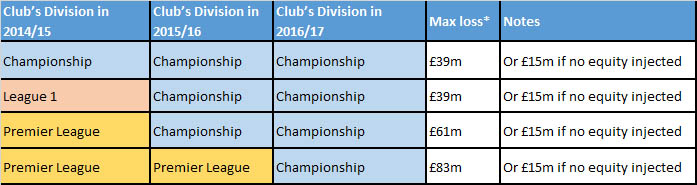
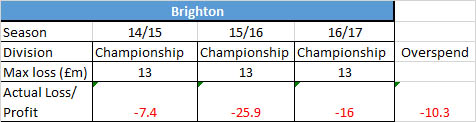
Championship clubs have voted 21-3 in favour of introducing strict new Financial Fair play rules.  Clubs that overspend will be punished with a Transfer embargo. The details are attached here.

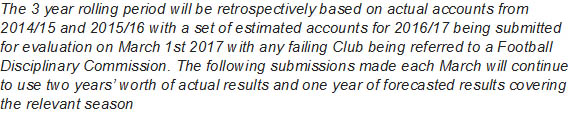
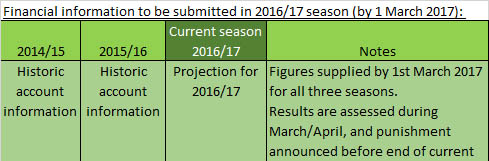
Plans to introduce a model that restricted clubs to spending a percentage of their turnover have been abandoned in favour of 'breakeven' model that restricts the level of losses a club can make.  In the face of practical and legal challenges (outlined in my previous article), the first sanctions will not now be in place until 1 January 2015, in the form of transfer embargoes.

The rules introduce the new 'Fair Play Tax', whereby clubs that overspend will have to pay  'Tax' that will then be shared out amongst the clubs that comply with the rules and remain in the Championship.  The introduction of this tax is dependent approval from the Premier League - gaining their approval is likely to be very difficult.  Reading, Southampton (and Leicester) voted against the proposals - this suggests that PL clubs may well not vote in favour of the Fair Play Tax.   However, this uncertainty only leaves the Fair Play Tax in doubt - all the other rules have been agreed.

Any club relegated from the Premier League will be exempt from the rules for one year - it will then have to comply fully or face a transfer embargo. It is probably this rule that will worry Premier League clubs the most as it makes it more risky for a club to spend heavily in an attempt to 'bounce-back' immediately.  There are a number of exclusions in the new rules, but Premier League clubs will have noticed that the cost of servicing existing debt is not amongst them. Some clubs, such as Aston Villa and Bolton, routinely pay around £5m a season to pay interest on their debt; the new rules will make life in the Championship particularly uncomfortable if the can't escape in the first year after relegation.

Interestingly, any promotion bonuses are exempt from the FFP calculations - we may see clubs structure their wages so that promotion bonuses make up a larger percentage of total pay.

Transfer Bans to be imposed next season in League 1 and League 2 29 April 2012

League 1 and 2 clubs have agreed to continue the Salary Cost Management Protocol (SCMP) and impose transfer embargos on overspending clubs from the start of next season (2012/13).

Under the SCMP, clubs needing to restrict spending on wages to a percentage of their turnover (55% in League 2, and 65% in League 1 reducing to 60% in 2013/14).  Clubs are required to submit regular up-to-date budgetary statements and forecasts throughout the season. The League will impose a transfer embargo as soon as a club is about to exceed the limits.

Scottish Premier League to impose "newco" rules following Rangers collapse 25 April 2012

The fall-out from Rangers financial collapse continues. Scottish Premier League (SPL) clubs will vote on new rules at the end of April that would be applied if a club enters Administration or if it suffers liquidation and is replaced by a new club (or "newco").

In future, any club entering administration would be docked 15 points (or 1/3 of their points at the time of the insolvency event, if that is a greater number of points).

Significantly, any "newco" would also be docked 10 points from the start of the next two seasons and would lose 75% of their SPL payments for the next three seasons.

On top of this, there is the UEFA impact.  UEFA require a club be a going concern, submitting accounts for three seasons before they are given a license to compete. Although Rangers have lobbied UEFA on this issue, it appears that a "newco" would effectively also suffer a three year UEFA ban.

Clubs would also be liable for any fine and/or transfer embargo imposed by SFA - Rangers have been hit by a fine for financial transgressions and had a 12 months transfer embargo imposed.

http://www.guardian.co.uk/football/blog/2012/apr/21/spl-financial-fair-play-rangers?newsfeed=true

City's FFP challenges and the implications for UEFA 19 April 2012

There has been a great deal of interest recently in whether Manchester City will pass UEFA's FFP test for the first Monitoring Period. The debate merits an explanation of how the FFP rules will apply to City and the implications for the club.

The first UEFA Monitoring Period covers the two seasons either side of the 2012 Summer Olympics (the 2011/2 and 2012/13 season. Clubs have to report losses below E45m (or £38m) over this two year period (i.e. an average loss of no more than £19m a season).  UEFA has 8 available punishments for a club that doesn't pass the FFP test and any punishment would commence from the 2014/15 season.   Although City lost £196m during the 2010/11 season, we won't know the scale of the loss for the 2011/12 season (i.e. the first season included in the Monitoring Period) until they release their accounts in November 2012.

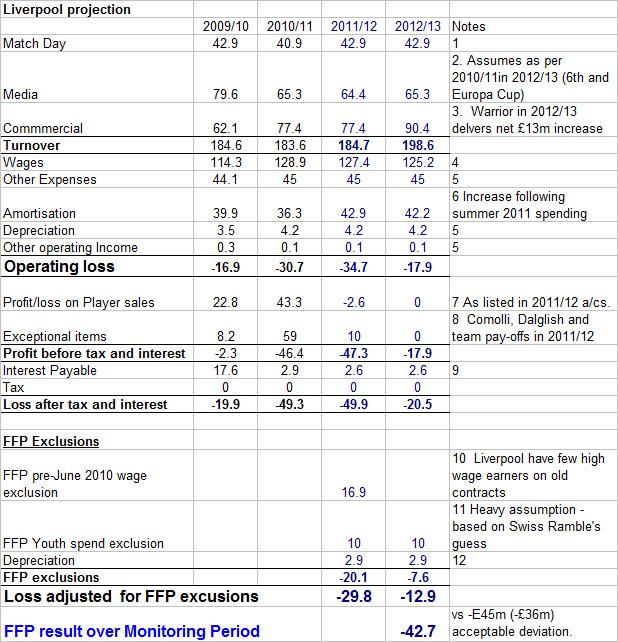
At first glance, reducing season losses from £196m to £19m might look like an unachievable task for City.  However I should direct readers to the excellent Swiss Ramble blog where he posts a detailed break-down of how City could possibly bring the losses down to just -£14m for the 2011/12 season.  For the 'Swiss Ramble' scenario to work, everything would have to have run in City's favour (including £10m transfer fees that don’t seem to have been achieved this season).  Although it would be a brave (or potentially foolish) person to argue with Swiss Ramble’s figures, for the 2011/12 season there is rather gaping hole for City in respect of the 2012/13 figures (the second year of the first Monitoring Period).  

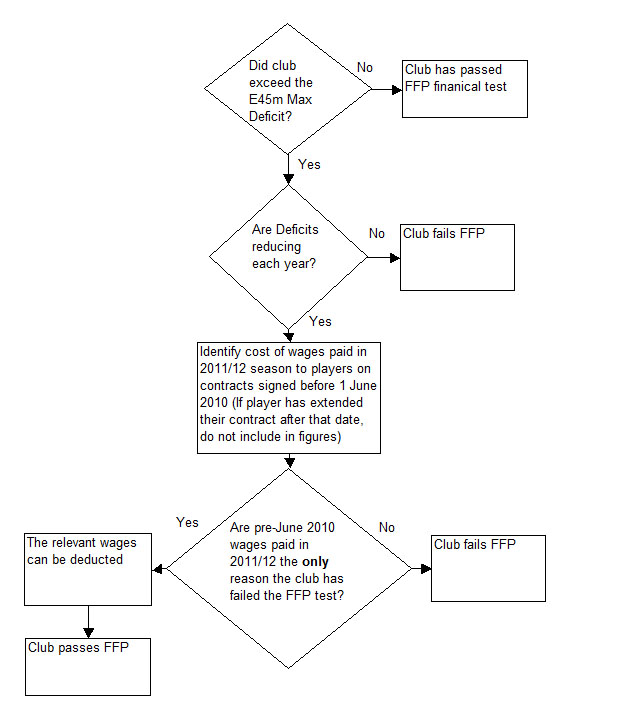
As Swiss Ramble points out, for the 2011/12 season, the FFP Break Even rules allow clubs to exclude wages for players signed before 1 June 2010. For City this equates to around £53m and is a key factor in the club reducing their debt close to UEFA’s permitted level.   N.B. UEFA’s wage exclusion is so crucial to this debate that I have attached the relevant text from the rules at the foot of the page.

However, this wage exemption only applies for one season only (2011/12). When calculating the deficit figure for the 2012/13 season, all wages must be included, irrespective of when the player was signed. City therefore have to include the £52m wage cost in 2012/13 and, all things being equal, this would push the projected loss up to around £67m for that season (or roughly double the permitted Break Even Deficit for the two combined seasons of the Monitoring period).

It therefore seems almost certain that City cannot meet the FFP requirements for the initial Monitoring Period.   

But “what about the record-breaking Etihad deal?” I hear you cry.  The £40m a year from Etihad will certainly help the club and, in time, could generate significant commercial income. However the receipts from Etihad have been included in Swiss Ramble’s projection and are unlikely to generate material additional income during the first Monitoring Period.

So, with City seemingly set to fail the Financial Fair Play test, we need to consider how UEFA will react.  For most people, the key question is whether UEFA will ban City from UEFA competitions.  Of course, no-one really knows which of their 8 available sanctions UEFA will impose. There are many contributing arguments on either side of the debate - there are factors influencing UEFA to act leniently but also many factors pushing them towards the harshest of punishments. Rather than speculate, I have outlined the main arguments and rationale for both positions: 

UEFA will be lenient because:

  • City have fairly modest debts (£43m) and debt is the most important issue in European football.
  • Banning a top English Club (potentially the English Champion) would devalue the UEFA competitions.
  • There are a number of clubs who look likely to fail the test - if too many are banned, the competition is devalued
  • Platini is likely to find life uncomfortable if a number of the top European clubs are banned - City may have safety in numbers and gain new allies with other clubs struggling to comply.
  • City's losses are trending in the right direction - UEFA will consider this as a mitigating factor.
  • UEFA are keen to phase-in the FFP rules so may be more lenient in the early Monitoring Periods
  • UEFA are required apply penalties in a fair and consistent way – it might be hard to exclude one non-compliant club whilst imposing a lesser punishment on another club that fails the test.

  • By Excluding a club, the punishment becomes self-fulfilling – a club that doesn’t receive the £25m-£50m of Champions League money is much more likely to fail subsequent Monitoring Periods.

UEFA will react harshly because:

  • There is a genuine concern in UEFA over the high levels debt and the amount of losses clubs are making.Platini has staked his reputation on FFP and has too much to lose by backing down. 
  • Platini and general secretary Gianni Infantino seem to be giving progressively more stern pronouncements on FFP. Recent statements included " There'll be no backtracking","  and "We (at UEFA) probably won't be popular but we have to do it, otherwise football will be destroyed"
  • FFP is supported by most UEFA members.
  • FFP is now an embedded part of the UEFA DNA.
  • Platini will probably fail to win the FIFA Presidency in 2015, if he abandons FFP as he needs European support
  • City look set to miss the Break Even Deficit figure by a significant margin.
  • City have not had much success in Europe and a ban would probably not have a huge impact on the competition's credibility.
  • City (and Chelsea) are not popular in Europe amongst other clubs.
  • The German clubs cannot make losses and are very much oppose to the wealthy benefactor model and City in particular.
  • The European Club Association (effectively the Trade Association for the top clubs) is headed by Rummenigge (one of the most outspoken opponents of City who even called for the club to be banned).
  • The European Commission (EC) approved the FFP rules (and even said they felt they were a good thing). Any club wishing to challenge the legality of FFP will need to go to the EC.
  • This year UEFA has significantly bolstered its legal department to ensure it can beat any legal challenge.
  • City are likely to be one of the more serious FFP transgressors, probably standing out from other clubs that fail the test.
  • Excluding City would present a fairly easy way for Platini to appear tough and serious on this issue.
  • UEFA is required to apply penalties in a fair and consistent way - Exclusion is a penalty that may well  meet this criteria
  • England's relationship with world football is far from ideal.

UEFA FFP Wage Exclusion paragraph: Annex XI (page 85)


2. For the purpose of the  first two monitoring periods, i.e. monitoring periods 
assessed in the seasons 2013/14 and  2014/15, the following additional 
transitional factor is to be considered by the Club Financial Control Panel: 

Players under contract before 1 June 2010  
If a licensee reports an aggregate break-even deficit that exceeds the 
acceptable deviation and it fulfils both  conditions described below then this 
would be taken into account in a favourable way. 
i) It reports a positive trend in the annual break-even results (proving it has 
implemented a concrete strategy for future compliance); and 
ii) It proves that the aggregate break-even deficit is only due to the annual 
break-even deficit of the reporting period ending in 2012 which in turn is 
due to contracts with players undertaken prior to 1 June 2010 (for the 
avoidance of doubt, all renegotiations on contracts undertaken after such 
date would not be taken into account). 
This means that a licensee that reports an aggregate break-even deficit that 
exceeds the acceptable deviation but that satisfies both conditions described 
under i) and ii) above should in principle not be sanctioned


 UEFA issue clearer FFP explanation 15 April 2012

The full UEFA FFP rules have been criticised as being overly-long and difficult to understand. To overcome this, UEFA have issued a summary guide which they distributed as part of a press pack.  It is recommended reading for anyone wanting to gain a better understanding of Financial Fair play. I have attached a link and have also put this on the FFP Explained page.

FFP Press Kit EN_FINAL_en _1_.pdf FFP Press Kit EN_FINAL_en _1_.pdf
Size : 505.653 Kb
Type : pdf

 FFP for Championship proving unexpectedly difficult and facing punishment delays 5 April 2

Football League proposals for the introduction of Financial Fair Play rules appear to have run into difficulty and a delay in implementing the rules looks increasingly likely.

In June 2011, the Football League (FL) announced that Financial Fair Play rules would be introduced into the Championship from the 2012/2013 season.  The FL set out a schedule that would have seen the proposals circulated and then ratified at their Quarterly Meeting of all 72 clubs in February.   However, the February date has been missed and clearly things haven't gone according to plan. When contacted, the Football League advised that the FFP proposals "are still being looked-into".  As the rules will need to be circulated, ratified and put in place by the end of July 2012, all the indications are that the implementation will now slip by at least a year.


The Football League faces a number of obstacles and even legal challenges in order to implement the new rules to curb spending.

The initial proposal was for Championship clubs to restrict their spending on wages to 60% of the turnover. Conceptually, this sounds fairly straight-forward.  However the devil is in the detail and some clubs are clearly not happy with the proposals - West Ham let it be known that they were considering a legal challenge as they felt the rules were unfair and would restrict a clubs ability to compete in the Premiership. Perhaps, somewhat missing the point of the FFP rules, it was also reported that West Ham also apparently "fear that transfer fees will fall in the Championship and League 1 and that ambitious clubs will be penalised".

The consultation process faces a number of challenges - one of them has been identifying who to actually consult.  Owing to relegation and promotion, turnover in the Championship is high (25% of teams leave the Championship each season), making it difficult to effectively consult. Potentially, the top half of League 1 and the bottom half of the Premiership should be involved in the consultation process. However this would dilute the input from the existing Championship clubs and, somewhat uncomfortably, allow clubs not in the Championship to have input to the rules of the division.

And then there is the thorny problem of how to punish clubs that break the rules - the initial proposal was for errant clubs to face a transfer ban as a first sanction, with possible points deductions for major offenders. As I outlined in the 4 April article, it will be difficult to impose fair and consistent  sanctions when financial targets that can be missed by one pound or tens of millions of pounds.

However as club accounts are produced retrospectively (i.e. they always relate to the previous season), there are difficulties in using historic figures as a deterrent.  In addition, any club living under a transfer ban for previous high wage-spend in the previous year might find itself shackled to their high-wage-earning players and unable to bring in cheaper replacements.  As an example of how complicated this issue is, it is worth looking at high-flying Championship club Southampton. They recently announced their results for last season (i.e. when in League 1).  They ran a wage-bill of 93% of turnover and lost £11.5m. However, this season they have increased their TV and Commercial income, sold Oxlade-Chamberlain and will probably come fairly close to Break-Even. Southampton also appear to be heading for the Premiership, where seemingly no punishment could be applied.   It would therefore be extremely hard to implement an appropriate and timely punishment system for a club like Southampton based on a rigid formula that could also applied fairly to Championship clubs and clubs relegated from the Premier League. The issue of how to handle clubs relegated from the Premier League highlights other problems, as Sports Lawyer, Daniel Geey explains, " it would be a very brave regulator to sanction clubs for breaching the FFP regulations for accounting periods when they were outside of the Championship".

There is also concern that the timescale for implementation has been too ambitious. Clubs in the Premier League were aware in 2009 that FFP rules were coming (the final rules being issued in 2010).  There is an appreciation that Championship clubs may need a similar time to adjust to the new financial restrictions (especially given the potential complexity of the rules).

It is important to remember that strictly speaking, no FFP rules currently apply, as such, in the Premier League. UEFA's FFP rules only apply to any club wishing to apply for a license to compete in UEFA competitions. Clubs are therefore not obliged to comply. Indeed it is entirely possible that the owners of some clubs will baulk at the rules requiring them to inject equity to cover club losses and may choose to rule themselves out of UEFA competitions.  The UEFA competitions are very much the 'icing on the cake' for Premier League clubs -the situation is entirely different for Championship clubs who face potentially complicated restrictions that will apply to their 'bread and butter' activity.

All this makes it difficult to envisage how the Football League can easily take FFP forward in the Championship. A more straight-forward approach may be called for, perhaps one that simply requires owners to convert losses to equity (or face a points deduction).  This approach would not be an entirely satisfactory solution as it would not address the issues around the wealthy-benefactor model and 'financial doping'. However, this alternative would at least impact on general spending levels and recent events suggest that increasing debt, rather than an excess of owner funds is the more pressing  issue outside the top flight.

Update: This article was used (with full permission) as the source for an article in the Independent on 5 April 

 http://www.danielgeey.com/UserFiles/FootballLeagueClubs.doc

http://www.dailymail.co.uk/sport/football/article-2002021/Football-League-sign-UEFAs-financial-fair-play-system.html

http://www.guardian.co.uk/football/2011/jun/08/championship-financial-fair-play

http://www.telegraph.co.uk/sport/football/teams/west-ham/8974105/West-Ham-considering-legal-moves-against-Football-Leagues-plans-for-financial-fair-play-rules.html


 UEFA publishes their 8 punishments for breaching FFP rules 4 April 2012

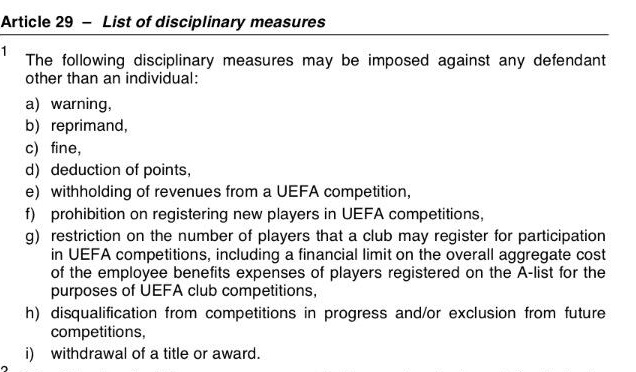
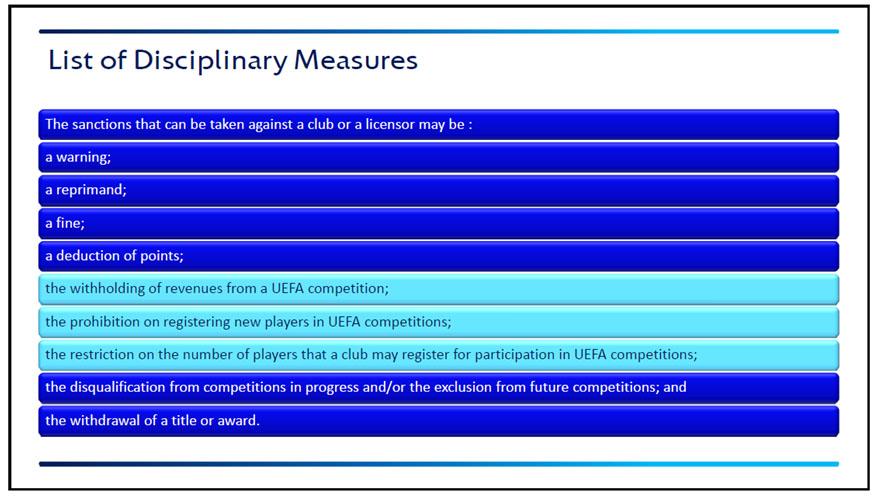
At the UEFA conference in Istanbul, UEFA ratified three more disciplinary measures for clubs that breach FFP rules.  As I outlined in my article on 7 Feb, five measures had previously been agreed at the Nyon Conference in January. The full menu of punishments now reads:

  1. Reprimand / Warning
  2. Fine
  3. Deduction of Points
  4. Withholding of Revenue from UEFA competition
  5. Prohibition to register new players for UEFA competitions;
  6. A restriction on the number of players that a club may register for UEFA competitions
  7. Disqualification from a competition in progress
  8. Exclusion from future competitions
Although the European Commission recently announced their approval of the Financial Fair Play regulations, there is a requirement for the rules and punishments to be applied in a fair and consistent manner.  Deciding which clubs receive which punishments and determining the severity of the punishment for all transgressions is likely to prove extremely problematic for Platini.  The FFP rules contain a huge number of potential transgressions, raging from overspend, to failure to have an under-10 youth team.  Even the financial requirements are wide-ranging and UEFA will be challenged when comparing rule-breaking such as  overspend, failure of an owner to inject equity and failure to be up-to date with taxes.   And once the relative seriousness of the crimes are evaluated, there will be issues to be determined within each crime. For example, should a club overspending by £1m be punished the same as one overspending by £50m?  Exclusion isn't an easily scalable punishment. And if the problem isn't difficult enough, UEFA has advised that it is keen to phase-in FFP over the next few years (presumably increasing the severity of the punishments).  When considering this potential minefild, UEFA needs to be mindful that it faces a potential legal challenge if the punishments are not applied fairly and consistently.

Platini has achieved a great deal and surprised many by getting the FFP rules this far - perhaps the hard part is only just beginning.
 

 Spending for a Competitive Advantage 1 April 2012

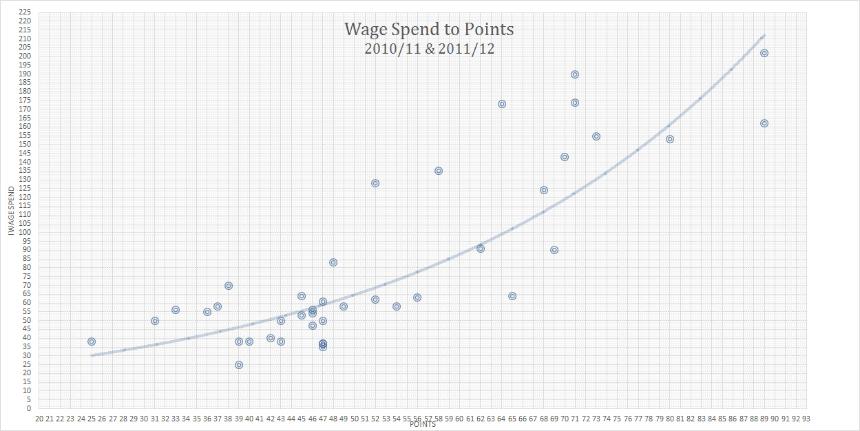
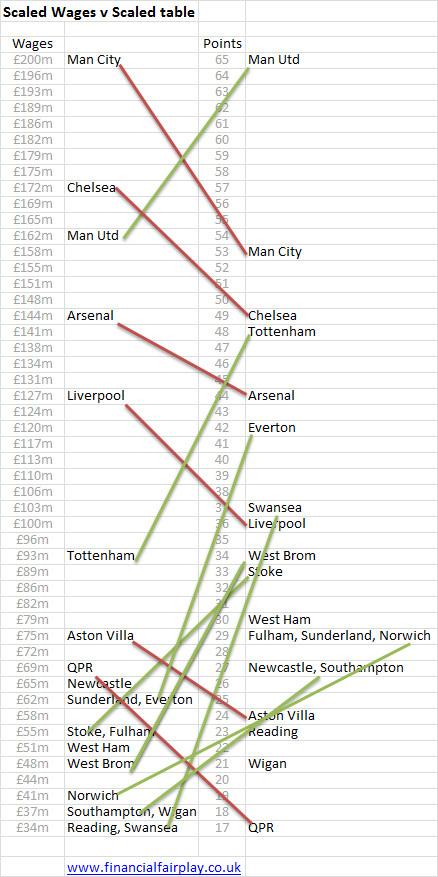
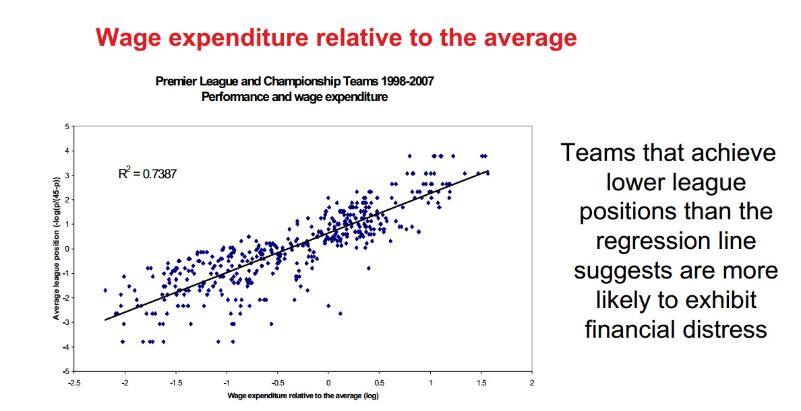
At the Soccerex conference in Manchester, one of football's foremost Administrators, Trever Birch  (with Leeds and Portsmouth on his CV), outlined how  "the Championship is a scene of carnage with clubs pursuing the Holy Grail of promotion, losing between £5 million £10m a year and a third of them spending over 100 per cent of turnover on wages."  Birch had previously explained that the problems at Portsmouth had resulted from the club aiming to gain a 'competitive advantage' by paying high wages.   I thought the attached graph from Cass Business School is relevant here and it shows how Premier League and Championship clubs' wage spend corresponds to league position:

As we would expect, the figures show that, in general terms,  the higher the wages, the higher the likely league position.  Once a club reduces its wage bill then it is less likely to achieve league success.    Interestingly, most 'outliers' are scattered significantly below the line and mainly amongst the clubs that spend less than the average.  These represent the clubs who spend below the average on wages and who suffer relegation-level failure on the pitch. This is interesting if we consider Birch's comments; any club that doesn't keep up with the average spend of their competitors becomes more likely to suffer catastrophic under-performance. This helps to explain the wage-escalation in the Championship and the Premier League; the risk of relegation is greatly reduced once a club pushes their wage-spend above average levels.  The problem with this scenario is that drives up the general level of wages - each year clubs need to spend more just to keep up with the average.

 UEFA close door on legal challenge and talks tough 29 March 2012

Last week was an truly excellent week for Platini and saw him secure approval from the European Commission to the Financial Fair Play rules. Platini has been concerned that any excluded club may challenge the legality of the punishment (hence he recently bolstered his legal dept) (see article from 16 March).  Approval from the European Commission was essential for Platini as he has now closed the door on any legal challenge.  He must have been delighted to see that they didn't just confirm the legality of the FFP regulations but went a step further and said that they supported the rules; "I believe it is essential for football clubs to have a solid financial foundation" said Joaquin Almunia, vice-president of the EC. As the attached article explains, any club wishing to complain about their FFP punishment has to take their grievance to ..... the European Commission.

Platini would have been aware of Commission's intention to approve the FFP rules when he gave his interview to AFP a few days earlier.  The statements from Platini are probably the toughest and most forthright pronouncements on his personal project: 

 " There'll be no backtracking",

 "We (at UEFA) probably won't be popular but we have to do it, otherwise football will be destroyed"

Platini said he was prepared to be in the firing line if clubs that transgress were banned from European competition but he said the rules were "important for the legitimacy and popularity" of the game

http://www.independent.co.uk/sport/football/news-and-comment/platini-wins-ec-backing-for-financial-fair-play-regulations-7580682.html

http://www.football.co.uk/manchester_city/fair_finance_vital_for_football_-_uefa_s_platini_rss2146563.shtml


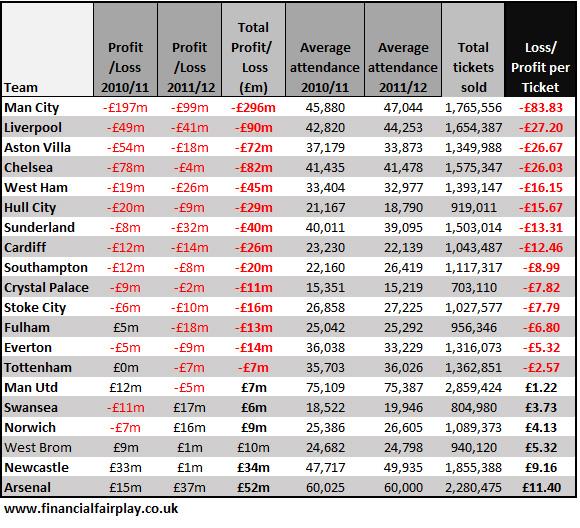
Analysis by www.financialfairplay.co.uk reveals the increased ticket price that clubs would need to charge if they were to manage on a 'break-even' basis and if the ticket prices were increased to account for the shortfall.  The study of Premier League finances reveals that fans receive match-day ticket subsidies averaging at £25 per ticket.  Although Man City's place at the top of the subsidy table will surprise few, the level of loss per ticket sold (£161) is somewhat shocking.  Perhaps more surprising are the unsustainable subsidies provided to Aston Villa and Bolton fans (£63 and £49 respectively).


The analysis is based on Profit Before Tax for Premiership clubs over the past 3 seasons - any loss is apportioned to the number of tickets sold over that period (based on home attendances over the period).  Few clubs have consistently made a profit during the last three years.  Arsenal stand out as a profit-making club, but we need to remember that these figures represent profit before tax; after tax and amortisation of player contracts, the club barely broke even in the 2010/11 season (making £2.2m profit).


TeamProfit /Loss  (£m) 2008/9Profit /Loss  (£m) 2009/10Profit /Loss  (£m) 2010/11Total Profit/   Loss (£m)Average Profit/ Loss (£m)Average AttendanceProfit/Loss per   home gameProfit/Loss per ticket soldProfit/Loss per season ticket
Man City-£92.6-£121.3-£197.5-£411.4-£137.144,764-£7,217,544-£161-£3,063
Chelsea-£44.3-£70.4-£67.7-£182.4-£60.841,482-£3,200,000-£77-£1,466
Aston Villa-£46.2-£37.6-£54.0-£137.8-£45.938,526-£2,417,544-£63-£1,192
QPR*-£18.8-£13.7   *-£32.5-£16.314,358-£706,522-£49-£935
Bolton-£13.2-£35.4-£12.4-£61.0-£20.322,411-£1,070,175-£48-£907
Sunderland*-£26.5-£27.9   *-£54.4-£27.240,178-£1,431,579-£36-£677
Liverpool*-£16.1-£19.9   *-£36.0-£18.043,098-£947,368-£22-£418
Newcastle-£15.2-£33.5-£3.9-£52.6-£17.546,618-£862,295-£18-£351
Wigan-£5.8-£4.0-£7.2-£17.0-£5.717,723-£298,246-£17-£320
Fulham-£8.4-£16.9£4.4-£20.9-£7.024,430-£366,667-£15-£285
Blackburn£3.6-£1.9-£18.6-£16.9-£5.624,635-£296,491-£12-£229
Norwich-£5.6-£5.8-£3.9-£15.3-£5.124,894-£221,739-£9-£169
Swansea-£0.5£0.6-£8.2-£8.1-£2.715,427-£117,391-£8-£145
Everton-£6.9-£3.1-£5.4-£15.4-£5.136,143-£270,175-£7-£142
Stoke£0.5-£4.0-£7.4-£10.9-£3.627,004-£191,053-£7-£134
West Brom-£12.3£0.5£9.0-£2.8-£0.924,236-£45,902-£2-£36
Wolves-£5.0£9.1£2.2£6.3£2.126,738£103,279 £4£73
Tottenham£33.4-£6.5£0.4£27.3£9.136,119£478,947  £13£252
Man Utd£48.2-£15.0£29.7£62.9£21.075,092£1,103,509 £15£279
Arsenal£36.7£45.5£14.8£97.0£32.359,997£1,701,754 £28£539
Average-£25
*2010/11 figures not available -  Average loss calculated over two seasons
Profit/Loss figures shown are Profit Before Tax (or on a consistent basis)


At current levels of club expenditure, the ticket price-rise required by most clubs to reach break-even would obviously be unrealistic - current Premier League tickets are amongst the most expensive in Europe and fans are generally oppose to further real-term price increases.   

Clubs are searching for a competitive advantage through their overspend; they seek the riches of the Champions League and fight to avoid the financial wasteland of relegation.  Football fans are also fairly quick to encourage club owners to increase spending.  Antonov (the disgraced former owner of Portsmouth) pointed to the pressure from fans as key reason for the club's overspend - he explained that ‘it was "simply impossible" for Portsmouth to stay within its means and "satisfy supporters' expectations. Even at Arsenal, Wenger has frequently been urged to 'spend some money' (despite the club's recent profits being fairly modest). However, it is clearly the responsibility of the club management to ensure they resist excessive expenditure and run their clubs in a prudent manner.

It is important to consider the source of the funds for the 'ticket-subsidy'.  At Man City, Sheikh Mansour routinely injects cash to convert losses into equity - consequently the club has debts of £43m.  At Aston Villa, Randy Lerner has similarly converted £133m into shares - however the club also has long-term debts of around £130m owed to Lerner's family trust and has to service £6m in interest payments annually (the equivalent of around 12,000 Season Tickets). Relegation-threatened Bolton Wanders probably look even more precarious - they are £110m in debt, financed by £100m owed to Eddie Davies plus an overdraft facility with Barclays.  The club paid over £5m in interest payments last season (equating to around 10,000 Season tickets).

Ticket sales & Match Day Income) represents just one of the three main income streams for the club (the other two being Media/TV and Commercial income). Of the three, Media/TV income is the most important to all Premier League clubs -  again using Aston Villa as an example, the breakdown of these income stream elements in 2010/11 was, £21m Match Day, £54m Media/TV, £17m Commercial income.   It could therefore be argued that rather than a loss-making club effectively subsidising fans' Match Day tickets, it is, in part, the TV audiences who are benefiting from being able to watch a dazzling array of highly paid talent, whilst paying significantly below the market rate. As a counter-argument, it should be remembered that Sky are very astute and regularly test the market to ensure their packages are priced to maximise income without increasing cancellations. TV Football subscriptions are currently fairly expensive in the UK compared to other leagues -  for example Sky Deutschland offers a package showing every single Bundesliga game live, plus premium movies, for around £28pm (i.e. a lower price than the UK equivalent).

If revenues cannot easily be increased, the clubs will need to address the thorny problem of excessive player wages.  Currently, if a club doesn't play-ball and spend heavily on wages, it will find it hard to compete with those that do -  it is probably no coincidence that the Wolves, the only 'mid-size' club currently breaking even, are facing relegation.

Under the FFP rules, the owners of a loss making club are required to convert any annual losses in excess of E5m into equity. This should add some stability to club finances and ensure clubs aren't saddled with growing debt levels.  For some time, there has been an expectation that FFP will influence market forces to help drive down player wages and restore club finances to something approaching sanity. However, like a journeyman centre-half, the situation has been slow to turn.  As a consequence of the Bosman rule, clubs will often lock their top players into 4 and 5 year contracts - this makes it very difficult for clubs to introduce lower wage contracts into their squad.  The other issue delaying the reduction of player wages is the operation of the free market.  With the likes of Man City, Chelsea and even new boys QPR injecting cash into football via wealthy owners, it is hard for clubs to retain and acquire players without paying premium prices (as demonstrated when Arsenal lost Nasri to high wage-paying Man City).

Although Premier League clubs have changed behaviour as a result of FFP (activity in the January Transfer Window was 70% down on the previous year), clubs generally haven't made the changes quickly or deep enough. The 'sugar daddy' clubs continue to record huge losses, and the rest keep spending to try to keep up.   UEFA has tried to phase-in the changes so that clubs slowly adapt to the new environment.  However, irrespective of the new rules and Platini's frequent pronouncements, there is still a persistent view that UEFA will not follow-through with their ultimate sanction of 'exclusion' and that clubs will instead receive the proverbial smack on the wrist.   There remains a real risk that UEFA will ultimately be forced to exclude teams  'pour encourager les autres'.  If this happens and clubs suddenly take UEFA's stance seriously, the results could be disastrous; transfer fees would fall through the floor (leaving many clubs unable to clear existing debt); and clubs would find themselves locked-into unaffordable long-term player-contracts.


 Spanish Tax debt causes stir in Germany 20 March

Last week, questions were asked in the Spanish parliament about the amount of tax that was owed by Spanish clubs to the government.  The government was forced to admit that it was owed  €752m in back taxes (including 48m owed by Barcelona and 155m owed by Atletico Madrid).  The issue was quickly compounded by the Sports Minister Miguel Cardenel brazenly announcing that they were looking at ways that debt could be written-off.  The reaction from German clubs was fairly stinging: Bild's sports page on Tuesday ran with the headline "Will German taxpayers eventually have to fork out for Messi and Ronaldo?" 


On Thursday (16 March), Cardenal made a u-turn and said the football clubs' debt would no longer be wiped from the books."We are working to provide a solution to the problem. What the government can offer are policy instruments so that the clubs can cope with this situation, but neither will forgive the debt or provide more subsidies, " 

There is an interesting Financial Fair Play element to this issue. FFP rules state that a club will fail the FFP test if it is not up-to-date with its tax
payments (Article 50) - see attached extracts below. FFP rules dictate that the Spanish clubs have until 31 March to agree terms in writing with the Spanish tax authorities (if they haven't already done so).  This probably won't be an obstacle given the comments from the Sports Minister, but given the recent German focus, it will make any future decision to waive the tax liability much more difficult. 


Article 50 – No overdue payables towards employees and social/tax authorities
1 The licence applicant must prove that as at 31 March preceding the licence season it has no overdue payables (as defined in Annex VIII) towards its employees or social and tax authorities as a result of contractual and legal obligations towards its employees that arose prior to the previous 31
December.

ANNEX VIII: Notion of ‘overdue payables’
2. Payables are not considered as overdue, within the meaning of these regulations, if the licence applicant/licensee (i.e. debtor club) is able
to prove by31 March... that:
b) it has concluded an agreement which has been accepted in writing by the creditor to extend the deadline for payment beyond the applicable deadline

See attached article from the Independent:

 UEFA boosts legal dept to face FFP challenges 16 March 2012

David Conn of the Guardian is one of the most informed journalists regarding FFP. He has contributed to a particularly interesting article produced by CNN.  He outlines that UEFA are "readying themselves for legal challenges from top clubs and sending out a clear message they will be able to counter them," Conn points to the strengthening of the UEFA licensing and legal team with the appointment of top English lawyer Alasdair Bell."

http://edition.cnn.com/2012/03/15/sport/football/football-uefa-clubs-debt/?hpt=isp_t3

For more information about Bell's view of FFP, see this article written by Conn:

http://www.guardian.co.uk/football/2012/jan/25/uefa-financial-fair-play-rules

 The German footballing model 15 March 2012

Dan Storey at football365 has written an excellent article on the German footballing model. He makes some interesting points:

  • A minimum of 51% of each club must be owned by the club's members
  • Club members have the ability to directly affect the running of the club
  • A season ticket for Borussia Dortmund costs £152 for 17 domestic home games and one European game
  • Average attendance in the Bundesliga last season was 42,690 (7,000 more than the Premier League)
  • Due to the financial regulations imposed, Bundesliga clubs are less prone to signing players for exorbitant transfer fees
Of course, managing the clubs on a break-even basis prevents the clubs from paying very high wages and is felt to restrict success in UEFA competitions. One of the comments reads "the Bundesliga is probably the best league for fans, but not for actual football."

http://www.football365.com/f365-features/7593288/Why-The-German-Grass-Looks-Greener...

 Fans heavily subsidised by high-spending clubs 11 Mar 2012 

With UEFA keen to ensure clubs' expenditure matches their income, we have carried out some high-level analysis of the subsidy levels that fans currently enjoy.   Looking at two clubs currently in the media spotlight (Man City and Portsmouth), we have calculated how much extra the average fan would have to fork-out if they were to pay the market rate for their ticket (based on the club operating on a break even basis).  

The results are fairly staggering. Man City fans would have to pay an extra £3,053 a season for their season ticket (or £161 per game) if the owner were to ask the fans to make up the current operating loss through increased ticket prices.  It is easy to see why fans do not question or challenge the operating model of the club - the entertainment on offer would be considerably reduced if the club were to pay wages based solely on their operating income.   At City, the owner has injected equity into the club to cover the ongoing losses.  However, this has not been the situation at Pompey, where the club ran up debt of around £180m over their two recent Administration events. 

Pompey fans have enjoyed two Cup finals and 7 years in the top flight on gates of around 18,000.  However this has come at a considerable cost and over the last 8 years the club has lost around £1m for each home league game.  If fans had had to put their hands in their pockets to pay the full rate for the talent on offer, their season tickets would have been around £1,250 more expensive.   Clearly fans would not buy tickets at the 'unsubsidised' rate - for those clubs competing with the high-spenders and operating on a break-even basis, Financial Fair Play cannot come soon enough.

Man City
Loss per seasonAve Crowd
2008/9£92,000,00042,900
2009/10£121,000,00045,512
2010/11£197,000,00045,880
£410,000,000134,292
Average over 3 season£136,666,66744,764
Home games per season19
Loss per game£7,192,982
Subsidy for each ticket£161
Subsidy for season for 1 supporter£3,053
Portsmouth
LossAve crowd
Loss over 8 years£180,000,00018,000
Average no. Home games per season21
Loss per game£1,071,428
Subsidy for each ticket£60
Subsidy for season for 1 supporter: £1250 

Chelsea  hit hard by AVB adventure 10 Mar 2012

Under FFP regulations the cost of acquiring a player's contract (i.e. the transfer fee) has to be written off over the life of the contract.  However, the same restriction does not apply to other contracts. The cost of acquiring a manager's contract (eg.  André Villas-Boas) can be written-off immediately as a one-off hit against that year's financial results.  When Chelsea sacked Ancelotti, they decided to write off the cost of paying up his contract AND the cost of the acquiring AVB's contract from Porto in the same financial year. This action resulted in a one-off expense of around £28m in accounts up to the end of the 2010/2011 season. They chose the immediate write-off because FFP monitoring did not commence until the start of the current season; Chelsea must have felt the impact of firing and hiring a new manager would not have an impact on FFP calculations. However, now that AVB has been dismissed, Chelsea are faced with daunting prospect of having to write down the cost of paying up AVB's contract (around £10m) plus the cost of buying-out a new manager's contract during the first year of FFP monitoring. Chelsea lost £71m during the 2010/2011 season and also faced with the expensive task of rebuilding an ageing squad  - this unplanned managerial cost has hit them at the wrong time and meeting the FFP requirements seems to be beyond them.

Sanctions to be ratified on 20-21 March in Istanbul 7 Feb 2012

At the 24/25 Jan Executive Committee in Nyon, a number penalties for failing to meeting FFP criteria were agreed. Three sanctions are still to be approved and will be tabled at UEFA EXCO in Istanbul at the end of March.  The Media Pack has been attached at the foot of this article and outlined the penalties as follows:

Potential Sanctions
  • Reprimand / Warning
  • Fine
  • Deduction of Points
  • Withholding of Revenue from UEFA competition
  • Prohibition to register new players for UEFA competitions;
  • A restriction on the number of players that a club may register for UEFA competitions
  • Disqualification from a competition in progress
  • Exclusion from future competitions
*shaded blue - new sanctions still to be approved by UEFA congress next March

The 'Deduction of Points' sanction is interesting in that it has not been tabled previously by UEFA or publicly proposed by Platini. This punishment would seemingly apply to Group games in the both the Europa League and Champions League and offers a rather ingenious way of punishing clubs whilst still allowing them to compete in competitions at full strength.  It is interesting that this new punishment has been proposed and agreed at Nyon, suggesting that may well be be a favoured punishment.  

The 'Disqualification from competition in progress' punishment is rather perplexing and it is difficult to envisage a situation where UEFA would apply this sanction for FFP transgression.

Of the punishments that will be ratified in Instanbul, it is interesting to see the much-touted 'Transfer Ban' punishment has, as expected, been watered down so that player registration restrictions would apply to UEFA competitions only. UEFA have previously been concerned about the
about restraint-of-trade issues that would arise following a full ban on player registration.

The 'Restriction on the number of players that a club may register for UEFA competitions' offers some interesting possibilities. However the delightful prospect of a team being forced to field a team of fewer than 11 players seems unlikely!

Although the menu of punishments has nearly been finalised, we are yet to find out what level of non-compliance would trigger a particular punishment. 

The bell tolls for Pompey 2 Feb 12

If Michel Platini lies awake at night wondering about the wisdom of pressing ahead with FFP regulations, he might do well to consider events at Portsmouth.

Pompey went in Administration in 2010 having run up debts of around £135m. The club had adopted a wage structure that could only ever be sustained through cash injections from the Gaydamak family. Once the funds dried up, the club found they could not pay the wages and Administration followed.

In a recent interview with Express FM, CEO Lampitt advised that by the time the club came out of Administration, Pompey had managed to get the P&L account to a broadly break-even level.  However, when the club was then acquired by 
Vladimir Antonov (via a holding company called CSI), the club changed it's financial approach. Clearly not mindful of the lessons of the recent past, Lampitt proceeded to use a £10.5m loan (as oppose to equity) from CSI to boost the playing staff.  Players such as Huseklepp (£1.5m) and Pearce (500k) were purchased.  Within a short period of time, the club had yet again adopted a wage structure that could only be sustained through cash injections form their overseas owner.  When Antonov was arrested (for appropriating his Baltic banks’ customer deposits) Pompey found that once again they could not pay the player wages.  Lampitt points out that his spending was not at the same level as his pilloried predecessor Peter Storrie and that the Football League had also been taken-in by the Antonov’s ‘proof of funds’ documentation.  Although many fans believe he is culpable for their current plight, if the CEO is to be believed, Portsmouth have simply been extraordinarily unlucky.


At the time of writing, Pompey fans fear that the situation is so grave that the club may even by-pass Administration and simply be wound up.  The nightmare at Portsmouth illustrates the danger of ‘light-touch’ governance and will surely give Platini some comfort in his plans for a more prescriptive approach to football financing.

 Rummenigge calls for City to be banned - Mancini takes the bait 6 Dec 2011

A public argument has broken out between Bayern Munich and Man City over the penalties for breaching Financial Fair Play regulations. In an interview with Austrian website www.90minuten.at Bayern CEO Rummenigge makes a stinging attack on City’s spending and expressly calls for UEFA to exclude them from European competion..  Rummenigge explains:

“I recommend that Uefa should think of harsh punishments, otherwise there will be no financial fair play.

“Let’s take the example of Manchester City. How does it work when you write about 200 million (£194.9m) loss?

“The working group of the Uefa is required here to establish strict penalties. Some clubs want leniency, but in the final analysis, only the exclusion from the international competitions or the non-licensing for the European competitions or Champions League place (is appropriate.)

Rummenigge also went on to outline the reasons that Dutch, Belgium and Austrian clubs should all get behind the FFP proposals.

Perhaps somewhat unwisely, Mancini decided to hit back at Rummenigge’s comments. Mancini explained

"This has been six months now that he talks against us. He says he hopes Napoli get through to the second stage [instead of City]. “But you don’t want to see an important man like Rummenigge, who is the Bayern Munich president and a representative of a top club in the world, saying things against us. There are other teams in Europe that have a problem with Financial Fair Play, not only Manchester City.”

Although, Mancini’s comments "I think Manchester City are working for this FFP for the next two years” will have raised some eyerows given that the club lost nearly £200m in the financial year that ended just 5 months ago.

Original article

http://90minuten.at/index.php/sportsbusiness/sportsbusinessnews/61-fussball/46098-rummenigge-fussball-muss-wieder-fairer-und-rationaler-werden

Summary and improved translation of Rummenigge’s comments:

http://www.telegraph.co.uk/sport/football/teams/manchester-city/8936900/Manchester-City-v-Bayern-Munich-Bayern-chairman-wants-Euro-ban-for-clubs-who-break-financial-rules.html

Mancini hits back

http://www.telegraph.co.uk/sport/football/teams/manchester-city/8937994/Manchester-City-v-Bayern-Munich-Roberto-Mancini-tells-rivals-to-stop-sniping-over-clubs-finances.html


 Novel punishment proposed for FFP breaches 26 November 2011

With a UEFA committee due to meet in January to determine the punishment tariff for FFP breaches, an interesting suggestion has been proposed by a blogger at http://www.maracanazo.com/ .  UEFA's previous plan to impose a transfer ban for certain FFP breaches seems to have hit the buffers (due to restraint-of-trade issues and the fact that control of player registrations rests with FIFA and national associations, rather than UEFA).  The enterprising blogger proposes that teams who enter the Group Stage of the Champions League (and Europa League) would be docked points based on the level of FFP overspend. The devil is always in the detail, but with UEFA seemingly having few tools in at their disposal to punish transgressors, we might not have heard the last of this idea.

 UEFA shelves Transfer Ban punishment 24 November 2011

The Telegraph published a significant FFP article which maintains that UEFA have had to withdraw one of the proposed punishments for exceeding the Break Even deficit. The use of a transfer ban was put forward as a favoured punishment at the ECA in September (see article below). However it appears such a ban would fail the EC's restraint-of-trade rules.  This seemingly leaves UEFA with only three options:

  1. Levy fines as a punishment (however the irony of being able to buy your way out of the Financial Fair Play requirements will not be lost on many UEFA members).
  2. Defer FFP until after Blatter retires from FIFA in 2015 and is replaced by Platini. 
  3. Impose UEFA competition bans on the worst FFP transgressors 

Of the three options, UEFA may decide to defer FFP implementation and punishment, citing the Eurozone/recession problems as the reason behind the delay.

http://www.telegraph.co.uk/sport/football/european/8908065/Uefa-shelves-proposals-to-impose-a-transfer-ban-on-clubs-that-breach-its-financial-fair-play-rules.html#disqus_thread


 Media confusion over first Monitoring Period20 November 2011

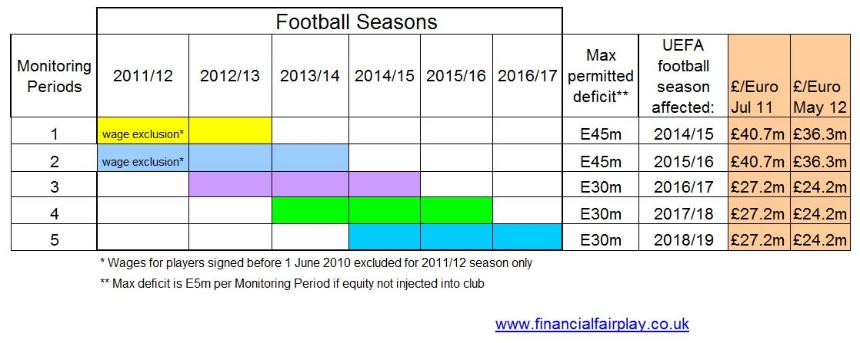
In the rush to comment on City's recently announced £195m loss, a number of columnists have submitted incorrect copy regarding the duration of the current Monitoring Period.  The error seems to have started in a Press Association article on 18 November and has been included in a number of separate articles, including those in the Guardian, Telegraph and Mail.  To clarify, the current Monitoring Period lasts for TWO years (not three) - clubs must restrict losses to a maximum of E45m over the two years. The UEFA rules state on page 34:

'the first monitoring period assessed in the licence season 2013/14 covers only two reporting periods, i.e. reporting periods ending the first monitoring period assessed in the licence in 2013.' 

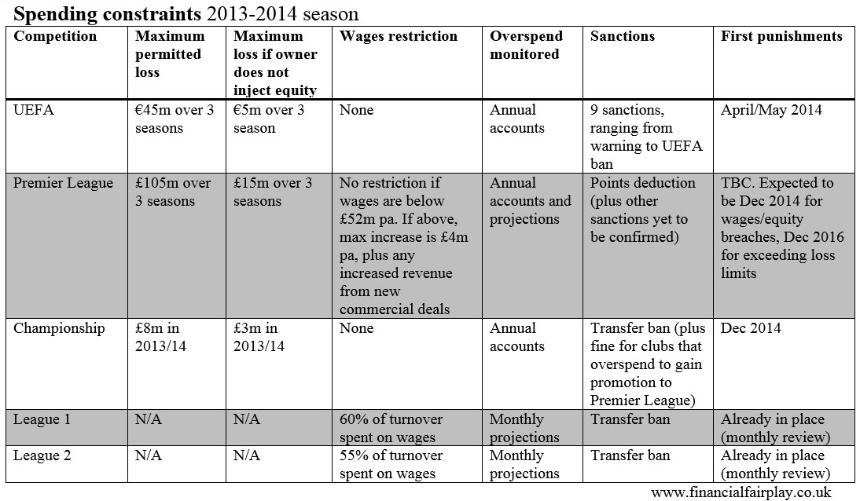
Subsequent Monitoring Periods will run for three years - see our attached grid:

 City take downbeat tone on meeting FFP criteria 18 November 2011

Man City today announces losses of £195m for 2010/11 season. Significantly their public tone suggests that they are struggling to meet the FFP criteria for the first Monitoring Period.  The club announced:

"As we undertake the club's commercial transformation, we are cognisant of the incoming Uefa financial fair play regulations and consequently we continue to maintain positive and ongoing dialogue with all appropriate football authorities."

Being 'cognisant' of the regulations is not the same as having a realistic expectation of actually meeting the requirements.  Today was a bad day for City - had Blatter departed (following his 'shake hands to resolve racism' comments), Platini would have been a shoe-in for the head of FIFA. As it is, Platini will face a deafening chorus of anti-City sentiment from across Europe over the next few days (expect Bayern and Inter to express their views publicly).  City have no UEFA history to speak of and a ban would hardly devalue the Champions League.  The size of City's loss actually makes the position easier for Platini - he can strengthen his position by excluding City from European competition, whilst dishing out lesser penalties to other clubs who fail to meet the criteria.  In short, City are probably 'toast' but they have may well have saved Chelsea's bacon.

  Platini discusses watered down punishments 15 Oct 2011

Although the UEFA rules on Financial Fair Play, quite clearly spell out the punishments for clubs which overspend (non-compliance=no licence to compete), Platini has this week discussed imposing lesser punishments for rogue clubs (see link below).  In the Der Spiegel interview Platini discussed 'a range of possible sanctions' with exclusion being one of them.  Interestingly, the concept of reduced punishments such as fining clubs and/or imposing a transfer ban were previously raised at the European Club Association (ECA) on 7 Sept by Financial Fair Play strugglers Inter (see article below). 

As the scale of FFP non-compliance is becoming apparent, Platini is clearly keen to ensure that the UEFA competitions are not devalued.  However, the alternatives to a UEFA ban are not trouble-free options; the imposition of a fine (or withholding UEFA prize money) would be self-fulfilling and result in the club being less likely to achieve the FFP criteria. The imposition of a transfer ban would result in some UEFA games where clubs would, with some justification, claim their opposition had fielded players who should not have been on the pitch.

The UEFA rules are pretty clear about the punishments. Attached is extract from page 14 in Chapter 3:

..the criteria defined in this chapter must be fulfilled by clubs in order for them to be granted a licence to enter the UEFA club competitions.

The rules then go on to list the situations where a ban would not apply (these are listed and include failure to have a supporter liaison officer or youth coaches). Failure to meet the the financial Break-Even criteria within FFP not listed as an exception.

http://www.spiegel.de/international/zeitgeist/0,1518,791235,00.html

 Chelsea outline their plan for Financial Fair Play compliance 9 Oct 2011

Steve Tongue in the Independent on Sunday pulled together an excellent article on the challenges faced by Chelsea in order to comply with the Financial Fair Play rules.  Bruce Buck (Chelsea's Chairman) outlined the 4 actions the club will be taking:
  1. Reduced spend on transfer fees for new players
  2. Reduced spend on wages
  3. Increased sponsorship income (possibly including selling stadium naming rights)
  4. Increased match-day incomes
Of course this is easier said than done.  Match-day incomes can only be materially increased by following Arsenal's example and building a new stadium (and Buck seems to be suggesting that the club may not proceed with the new site). Chelsea have tried to sell the naming rights (reportedly for £100m) but had to admit defeat in the summer.  Given the perilous economic position world-wide, it will also prove difficult to attract substantially increased sponsorship deals. Wage spend and transfer fees are more within the club's control. However action in these areas will be difficult and potentially unpalatable for the supporters - the club will soon have to replace Lampard, Terry and Drogba and have a number of high-profile players locked into long-term contracts.

It will be a significant surprise if Chelsea are able to meet the FFP test for the first Monitoring Period. Chelsea's best chance of taking part in the Champions League in 2014/15 may be to work with fellow non-compliant teams, such as Inter and press for a delay or reduction in UEFA's punishment. Understandably, Buck is not yet ready to discuss this contentious option.

 FFP catches Sunderland Short 5 Oct 2011

It was interesting to see that Sunderland used 'Financial Fair Play requirements' as part of the justification for Niall Quinn's change of roles. In a move that signalled the increasing frustration of club owner Ellis Short, Quinn was this week replaced as club Chairman. In an unusual move, Ellis Short now becomes club Chairman.  Quinn will now focus on "developing Sunderland's profile and business interest overseas". Clearly,
all is not well at Sunderland. Gates are 3,000 down on last season (comparing the same fixtures over the two seasons); they are hovering
above the drop-zone with only one win this campaign, and the club have lost £23.5m and £25.5m over the last two seasons.  Ellis has sent Quinn to South Korea in an attempt to bring in some desperately needed commercial funding. Niall will have his work cut out - Sunderland are hardly a global brand and other, more successful, clubs with greater fan-appeal have been fishing in the same pond for several years.

When Quinn 'sold' the Sunderland vision to Short, it was very much portrayed as a 'Field of Dreams' - build it and people will come. Back in March 2010 Quinn said. "People say, ‘Why is he here?’ It's the potential which is why he’s putting all this money in; he wants the asset to grow and he feels in five to ten years that the asset will be worth far more than it would if he had just let it go. He feels it will be good value in time, especially with the way the world [television] rights are going.

After having pumped in £67.5m of his own money into the club over the last 18 months, the dream has turned into a bit of nightmare and success is
further away than ever . Short is seemingly not happy with Quinn's performance as Chairman and the Irishman faces a tough job to build the
brand in the Far East when the supporters in the North East are losing interest.
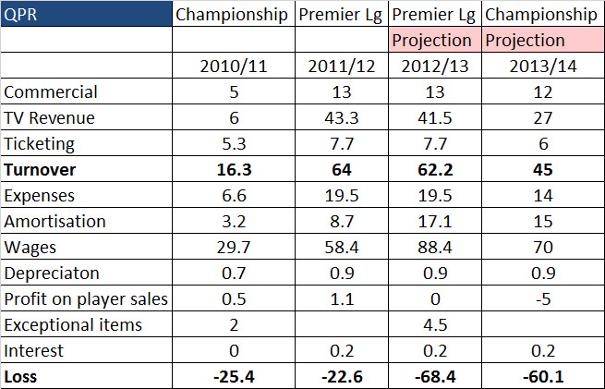
Ellis Short has dug-deep in his financial support for Sunderland - he put in £19m of equity (i.e. not loans) into the club earlier this year, in
addition to the £48.5m he stumped up the previous year. Short is a very wealthy individual and his personal wealth is usually given as $1.2b. However his background is in banking and investments (a sector that has seen 25% falls over the last quarter) so things may not be quite as rosy
for Ellis as they were this time last year.

Short is quite right to point out the FFP issue at Sunderland. However, the issue runs deeper than the obvious challenge of reducing the
club's losses to within the E45m maximum Break Even Deficit over the Monitoring Period that covers 2011/12 and 2012/13 seasons. Under FFP rules, a club is only able to lose more than E5m over the current two-year Monitoring Period if there is an injection of Equity to cover the loss.  This
means that Short will have to put his hand in his pocket yet again and fork-out up-to E40m.  This, of course, assumes that Sunderland will continue to apply for a UEFA licence on the off-chance that they will eventually secure for a the Europa Cup or Champions League place.


 Chelsea decision long overdue 4 Oct 2011

Stamford Bridge have known for some time that they need to improve the income generated from their Stamford Bridge stadium.  With a capacity of 42,000 and generating around £82m of match-day income each season, the stadium compares particularly poorly to Arsenal who are able to generated around £122m over the same period.  Of course Arsenal have the benefit of a shiny new stadium and wisely decided to build extensive corporate facilities in a successful effort to maximise the income derived from every home game.  Chelsea  have spent nearly two years agonising over how to proceed with Stamford Bridge - they have been trying to sell stadium naming rights since November 2009 (the club admitted defeat in the summer in its protracted bid to raise £100m in a 10-year naming-rights deal).  Now it looks like the club are about to take the decision it should have taken two years ago and start the drawn-out process of building a new stadium.  Unfortunately, it will take several years for the club to reap the benefit of the increased match-day income and in the interim it is faced with the tough challenge of trying to reduce losses to just E45m over the 2011/12 and the 2012/13 seasons combined.  Without the extra income a new stadium would provide and without the immediate prospect of an Etihad sized naming-rights deal, Chelsea may even fail the first FFP test.

 Owners asked to dig deep 2 Oct 2011

With the financial reporting season upon us, the impact of FFP is starting to hit home with club owners.  Although clubs are able to report a deficit of up to E45m during the current two-year Monitoring Period, clubs are only able to record this level of loss if the owners are willing to put their hands in their pocket and inject Equity that will cover all any deficit amount over E5m.  Where the owners are not willing to subsidise the club in this way, the maximum permitted loss is only E5m for the Monitoring Period that covers 2011/12 and 2012/13.  For the likes of Abramovic and Sheikh Mansour this will not present any problem but there are issues for other Premier League Clubs. All clubs wishing to take part in UEFA competitions are required to apply for their UEFA licence in advance of securing their qualification for the competitions.  In practice this means that the owners of Stoke, Newcastle, Bolton and the other clubs hoping to win an UEFA place will need to put their hands in their pockets to fund the deficit, rather than saddle the club with debt.
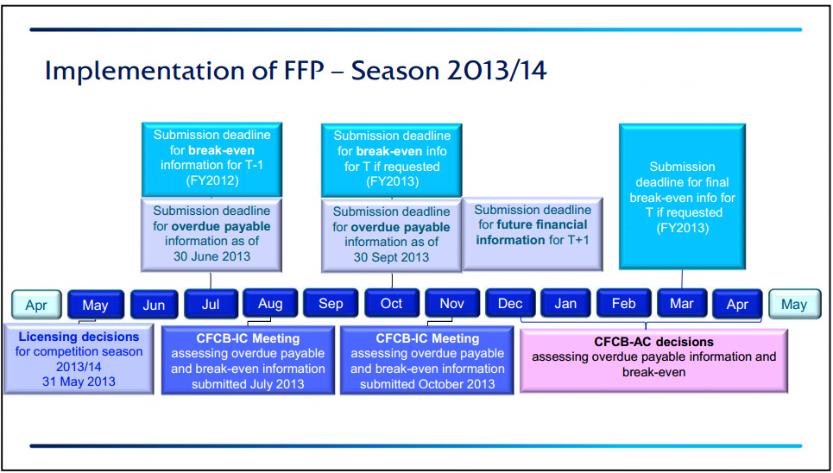
 

Arsenal can only break even 1 Oct 2011
Arsenal are viewed by UEFA as a role model - they play nice football, are not owned by a 'Sugar Daddy', they have built a lovely new stadium and operate on financial model that will seemingly ensure FFP compliance. UEFA will therefore have been pleased to read Arsenal's recent financial results (their last ones to be produced before the first Monitoring Period).  Although Arsenal announced a profit of £15m before tax, they recorded a profit of just £2.2m once transfers are factored in.   In many ways these results indicate how difficult several English clubs will find complying with the FFP rules - if Arsenal, with the benefits of their world-beating corporate facilities, few expensive player purchases and a reasonably rigid salary structure, can only break even, it will be extremely difficult for some of the other Premiership teams to comply.
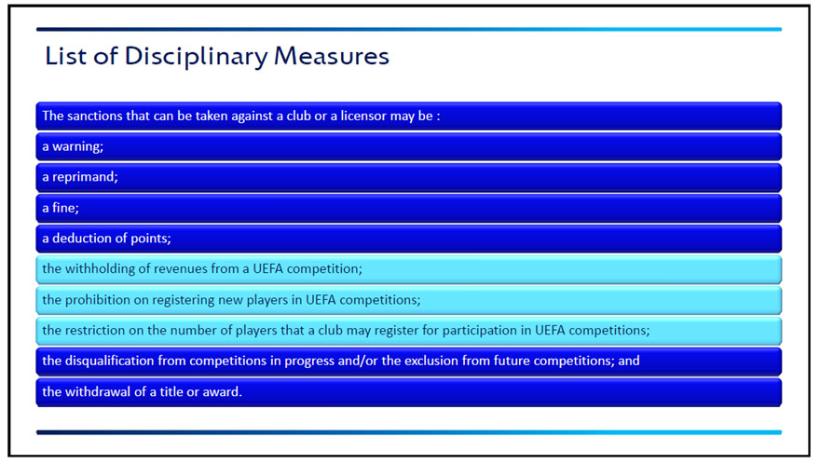
 How to solve a problem like Carlos 28 Sep 2011

Following Tevez' refusal to come of the bench against Bayern, a number of pundits proposed that Tevez should be 'sacked' or be 'left to rot in the reserves' for the rest of his contract. Other than the employment law issues surrounding these two proposals, there would also be a FFP impact:

Sacking option
Tevez was signed two years ago for a reported fee of around £45m/£48.  Under FFP rules, his value will have been 'amortised' or written-down and he now has a 'book value' of around £27m. If the club were to 'tear up his contract', City would immediately be hit by the 'loss' of all his book value in the current financial year. Whether they can still keep costs within the Break Even Deficit limit is debatable but a  one-off  'loss' of this size would probably be too much for City.

Running down contract in the reserves
As Tevez was signed before 30 June 2010, his wages are not counted as an expense for the 2011/12 season. However his wages do have to be accounted in full for the 2012/13 season (at around £13m).  The club would also have to amortise his purchase price for another year (costing around £9m for a full year). Again, City will be keen not to be impacted by £22m costs added to their Break Even Deficit.

Financially, the best option for City would be to sell him in Summer (or possibly January). However his value is probably greatly reduced and City would have planned to sell him for around £40m at the end of the season (making a profit of around £20m over his projected June 2012 book value). Unfortunately for City, they may struggle to raise much more than £20m for the player. Again, the absence of the planned book value profit on the sale of Tevez will hit the club's ability to meet the FFP criteria.

For more information on how contracts are 'amortised', click the Financial Fair Play Explained link above.

 Inter do not expect to meet FFP requirements 9 Sep 2011

Further light was shed on Inter's role in proposing lenient FFP punishment at the ECA conference, when Massimo Moratti, the Inter General President, announced that Inter are not ready currently meeting the FFP requirements. Suddenly it all becomes clear...


 European Club Association sub-group proposes FFP leniency 8 Sep 2011

Following the dissolution football's elite club organisation 'g14' in 2008, UEFA has sponsored the creation of the European Club Association. At the ECA conference in September, board member Ernesto Paolillo,(Internazionale General Director)  chaired a sub-group which convened to propose the penalties that they felt should apply for FFP breaches. Although all UEFA documentation is clear (i.e. non-compliance = no licence), surprisingly, the group proposed that the punishments should be withholding prize money and a transfer ban.  UEFA does not have to accept the 'recommendations' from the ECA but this episode must have left a few people wondering why this sub-group was convened and why the proposed punishments were not as severe as UEFA has indicated.

 Will the Etihad money be enough for City? 22 Aug 2011 

Etihad's reported £400m deal over 10 years includes a provision to spend around £100m on developing the stadium complex.  Although the numbers are not yet fully in the public domain, it seems around £30m a season will be earmarked to subsidise City's huge wage-bill in their quest to meet the FFP requirements. Given that City are currently running losing £100m+ every season, they face a seemingly impossible struggle to bring down the FFP deficit total  to under E45m for this season and the next.   Seemingly City's only hope would be if the Etihad deal were heavily
'front-end-loaded' - however a deal structured this way is likely to result in problems for further down the line if the City Academy and Hotel complex do not deliver significant results.

 Some clubs expected to fail FFP test 17 Aug 2011

Privately, a number of sports and financial journalists believe some clubs will fail the meet the FFP criteria. However people are reluctant to put
their heads over the parapet and say as-much publically.  Things are starting to change. In an article published by Reuters, Neil Patey from Ernst &Young (a former Abramovic adviser according to the Edinburgh Evening News) has stated publically that he expects some clubs to fail the FFP test. 

"If I was a betting man I would say one of the rich benefactor clubs will
fail to meet the regulations first time around," said Neil Patey, a soccer
industry adviser at global accountancy firm Ernst & Young. "I think there's
a high chance Chelsea, Man City and Inter Milan will fail (to balance their
books). If Barcelona and Manchester United failed, UEFA would find it
difficult to not have them in European competition and I think UEFA are
praying that doesn't happen."

 Record Etihad Deal12 Jul 2011

Eyebrows were certainly raised by the size of the Etihad sponsorship deal with Manchester City. Etihad, who are yet to report a profit and have a
similar sized fleet to UK-based Flybe, have reportedly paid City around £400m in a 10 year deal which will extend the existing shirt-sponsorship
deal and re-brand City's stadium complex as "The Etihad Campus".  Not all of the Etihad funds will be used to boost City's coffers for the purposes
of FFP - a reported £100m has been earmarked for an extensive development programme which provide a hotel, call centre, training pitches and a
state-of-the art Academy set-up.  Although any expenditure on the youth-team set-up and the the stadium infrastructure is exempt from FFP
calculations, the eventual financial benefits of such an investment can beused to offset the club's wage-spend.

Barcelona sponsorship - from heroes to zeros 19 May 2011

Barcelona unveiled their new shirt bearing the Qatar Foundation logo.  Barcelona President Sandro Rosell and coach Pep Guardiola championed Qatar's successful World Cup bid and were rewarded with the E170m 5-year deal just 8 days after the World Cup hosts for 2022 were announced. Barcelona had been struggling to comply with the FFP criteria and desperately needed the income from this huge deal. The Spanish FIFA delegation were also keen to arrange a reciprocal voting arrangement with Qatar that would have seen Spain hosts for the 2018 competition.  

The Qatar Foundation is a charity run by the Qatar ruling family and announces that it "aims to support Qatar on its journey from a carbon economy to a knowledge economy by unlocking human potential".  However, not everyone was happy at this piece of business - the former Barcelona President Joan Laporta did not attend the vote on shirt deal, saying that it made the Spanish champions look like Qatar's national team.  Prior to the Quatar deal, the club had previously given the Unicef logo pride of place on the centre of their shirts.